
Two Policies That Start From the Same Rule
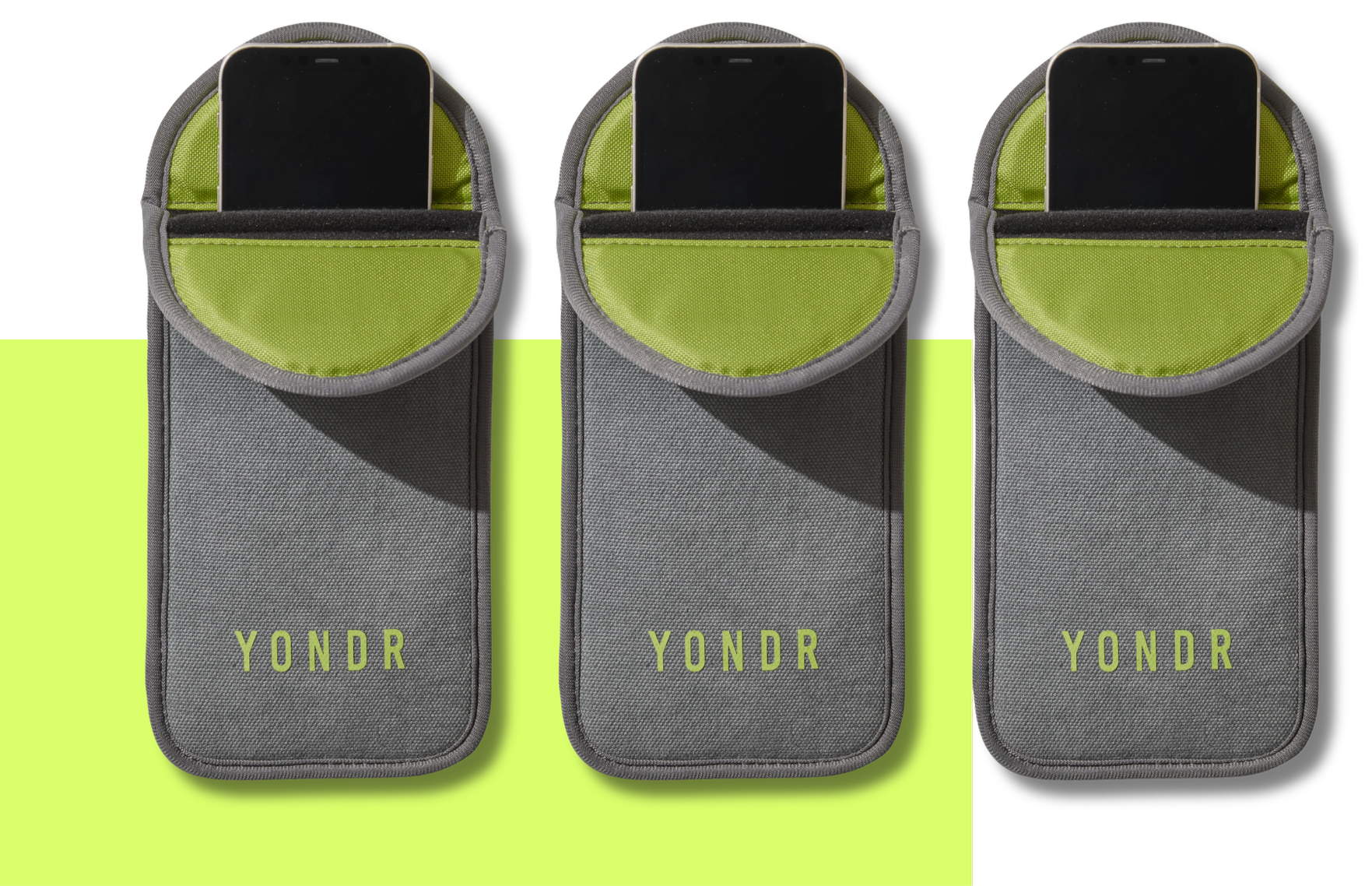
Many schools have started their journey to a phone-free culture with a policy commonly referred to as off-and-away. Sometimes called away for the day, students switch their phones off and keep them out of sight in a backpack, a pocket, or a locker, and it's up to teachers to enforce the rule when a phone appears. Many other schools have started this same journey using a more proactive Yondr phone-free program. In a Yondr program each phone is locked in a pouch that the student carries, and it stays locked until dismissal. While both kinds of schools have the same sentence in the handbook, no phones during the school day, and the approach, enforcement and burden on teachers is quite different.
In the largest national study of school phone restrictions to date, about 62 percent of schools have elected off-and-away as their first step into policy enforcement.
What the Largest Study Found
The study is a working paper that the National Bureau of Economic Research published in May 2026, written by economists at Stanford, Duke, the University of Pennsylvania, and the University of Michigan. It draws on data from more than 40,000 schools between 2019 and 2026 and compares schools that adopted Yondr with similar schools that didn't. Yondr supplied anonymized implementation data for it. Yondr did not fund the research, design the study, or review the findings before publication.
The clearest findings in the paper were about phone use:
Teachers reported that the share of students using phones in class for non-academic reasons fell from 61% to 13% in Yondr schools, an 80% reduction.
Between classes, Yondr schools cut phone use by 53 percentage points, nearly three times the reduction achieved by off-and-away policies alone, according to Yondr's summary of the study.
Teacher satisfaction with their school's phone policy went from about 26% to 75%.
Within two years, students in Yondr schools reported well-being improvements approaching double those documented in major social media deactivation research, per the same summary.
Why the Gap Opens Between Classes
Off-and-away can do its best work in a classroom, when there's a teacher who is responsible for enforcement and they are willing to consistently address phones, even if it requires them to stop a lesson or activity to do so. Often, there is not the same kind of responsibility or oversight in the hallways, the lunchroom, or the bathrooms, and the rule gets thin there. Teachers themselves report: among high school teachers whose schools have a cellphone policy, 60% told Pew Research Center that it's difficult to enforce.
A pouch moves enforcement to a single moment at the door and takes it off the teacher's desk for the rest of the day. Students still keep possession of their own phone; it isn't confiscated or collected, and it's never stored away from the student. Teachers are no longer asked to act as the phone police in every period.
Side-by-Side Comparison
| Yondr Phone-Free Program | Off-and-Away Policy | |
|---|---|---|
| Where the phone is | Locked in a pouch the student carries | Powered off in a backpack, pocket, or locker |
| Who enforces it | The routine at arrival; unlocking is governed by school policy at designated access points | Each teacher, in each class period |
| Hallways, lunch, and bathrooms | Phone stays locked from arrival to dismissal | Depends on who is watching |
| In-class phone use | Fell from 61% to 13% in the national study | Smaller reductions reported in schools without pouches |
| Between-class phone use | Down 53 percentage points | Roughly a third of that reduction |
| What the school receives | Pouches, unlocking equipment, policy consultation, staff training, launch and ongoing support | A written rule |
| Pricing model | One-time purchase; program implementation averages $22 to $25 per student | No purchase; the cost is staff time |
Where Each One Fits
Choose a Yondr phone-free program if...
Phones keep turning up in hallways, at lunch, and in bathrooms, the places where no teacher owns the rule.
Enforcement changes from one classroom to the next, and your students know which rooms are easy.
You want a partner to build the policy, train staff, and manage the rollout with families.
Choose an off-and-away policy if...
Few of your students carry phones, which is the case in many elementary schools.
Staff already enforce the rule consistently and phone use outside class isn't a problem.
You need a first step this term while a fuller program is being planned and budgeted.
What the Study Did Not Find
The research isn't a clean sweep, and a school should know that before it starts. Average effects on test scores were close to zero, with modest gains in high school math and small losses in middle school. Disciplinary incidents went up in the first year after adoption and then faded, and student well-being seemed to dip before it recovered and turned positive. Stanford's Thomas Dee, one of the authors, summed it up by saying that building a phone-free school is not a quick fix, and that the benefits may come as a school adjusts.
That first-year adjustment is the reason Yondr is built as a program. The pouch makes the phone-free environment possible. The policy work, staff training, family communication, and partner success support carry a school through the months when the rule is still new, and our guide to what schools are really buying when they choose Yondr makes that case in detail.
An off-and-away policy depends on each teacher asking for compliance, period after period, for as long as the policy lasts. Yondr changes behavior, and that change outlasts the deployment because the policy, training, and culture work are part of the program.
Talk to Yondr about building a phone-free program for your school or district.
FAQs
Does research show that phone pouches raise test scores?
Not on average, no. The 2026 national study found test score effects close to zero overall, with modest gains in high school math and small losses in middle school. The changes it did measure were in phone use, in teacher satisfaction with the policy, and in student well-being over time.
Can a school start with off-and-away and move to pouches later?
Yes, and many do. About 62 percent of the Yondr schools in the national study had an off-and-away style policy in place before they adopted pouches. Yondr's implementation team builds on whatever policy a school already has.
What does a Yondr program cost compared with a policy alone?
A written policy has no purchase price, although it costs staff time every day. Yondr is a one-time purchase with volume-based pricing, and program implementation averages $22 to $25 per student. What Yondr costs in 2026 breaks down what's included.
